Slavery
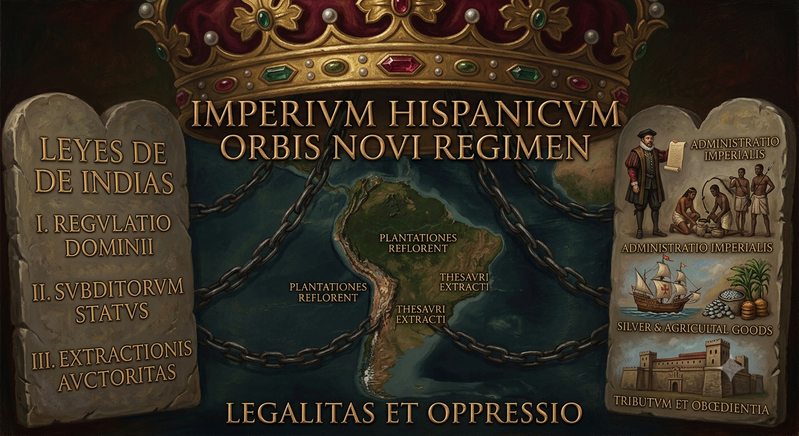
Ever wonder whether you may be considered property or not? Most of you have not, thankfully, but many have. It is not a new question either. It has been asked and answered multiple times throughout history. What is disturbing is how often the answer has been in the affirmative.
Today, such a notion seems unimaginable. To an African torn from his homeland and sold into slavery in South America, however, the answer was painfully obvious.
This raises a troubling question: can a human being legally become property?
Many people today claim slavery to be morally wrong, but it was legal, allowed, expected. For centuries. The Spanish Crown, like many other powers, had laws regulating the ownership, sale, inheritance, and punishment of enslaved people. The existence of those laws shows that legality and morality are not always the same thing.
The justifications for such practice usually fall into three categories: religious, economic and legal.
Some argued that non-Christians could be enslaved or that slavery helped "civilize" and convert people to Christianity. In other words, they claimed to be “saving their souls”. This allowed people to present domination as charity. This argument also conveniently supported an economic system that depended on a vast supply of labor for the colonies.
Plantations produced enormous wealth, and enslaved workers were viewed as economic assets rather than human beings with rights.
These justifications were backed by the law itself, which defined enslaved people as property, creating a very dangerous circular argument:
Why was slavery legal?
Because the law says enslaved people are property.
Why are they property?
Because the law says so.
If a parliament passes a law declaring a group of people to be property, does that make it morally acceptable?
Most people today would answer no.
This suggests that law does not create human dignity; human dignity should limit what law is allowed to do.
Modern legal systems generally recognize that every human possesses inherent rights that cannot be bought, sold, or transferred.
A person can own: a house, a car, a book but not another person.
Why?
Because ownership implies control, while human dignity implies autonomy.
The two concepts are fundamentally incompatible.
If a law can transform a person into property, what prevents that same law from stripping away other fundamental rights?
At what point does a legal system cease to protect human beings and begin to treat them as objects?
“Legum servi sumus ut liberi esse possimus.”
("We are servants of the laws so that we may be free.")
— Cicero, Pro Cluentio 146
Yet a law that transforms a human being into property serves neither freedom nor justice. It merely disguises oppression behind the authority of legislation.
Disclaimer: The content of this post is intended purely for educational, academic discussion, and theoretical research purposes. It represents analytical speculation based on historical and legal frameworks and does not constitute legal, financial, economic, or political advice.
Image Disclaimer
The image displayed above is an artistic interpretation created entirely using artificial intelligence (AI) technology. It is a work of synthesis and imagination generated through complex algorithms and does not represent real-world photography, physical artifacts, or specific historical events. All elements within the composition are synthetic.
© 2026 Lex in Tenebris. All Rights Reserved. No part of this publication may be reproduced, distributed, or transmitted in any form or by any means without the prior written permission of the author.
Comments
No comments yet. Be the first to comment!