Neocolonialism
Can a Nation Truly Be Free if Another State Controls Its Economy?
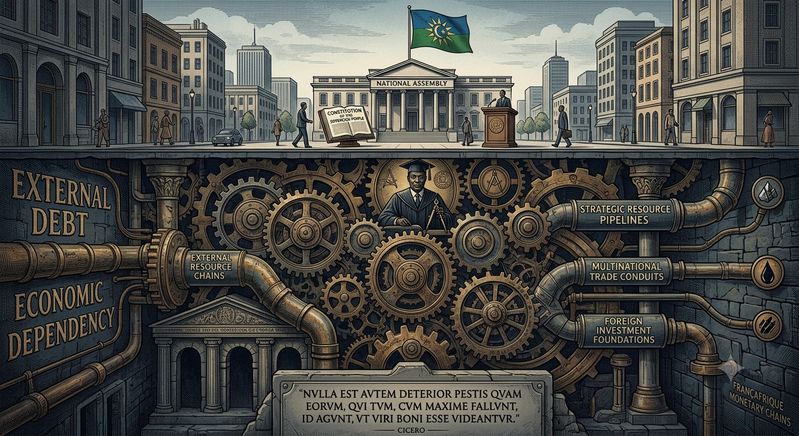
Do you consider a person free if someone else controls their income, dictates how they spend their money, and determines which opportunities are available to them?
Most people would answer no.
Yet this question extends far beyond individuals. It applies equally to nations.
For centuries, colonial powers exercised control through military conquest and direct political rule. Colonies were governed by foreign administrations, their resources extracted for the benefit of distant empires.
Today, most colonies no longer exist. Former colonial territories possess flags, constitutions, governments, and seats at the United Nations. On paper, they are sovereign states.
But does legal independence necessarily mean actual independence?
This question lies at the heart of neocolonialism.
The term was popularized by Kwame Nkrumah, the first president of Ghana, who described a system in which a state appears politically independent while its economic policies and development remain heavily influenced by external powers.¹
Unlike traditional colonialism, neocolonial influence is not exercised through armies or governors. Instead, it may operate through international financial institutions, trade agreements, foreign investment structures, debt obligations, and control over strategic resources.
Supporters of these mechanisms argue that they provide developing nations with capital, infrastructure, and access to global markets. Critics respond that such relationships often create long-term dependency and unequal bargaining power.²
One frequently cited example concerns Structural Adjustment Programs introduced by institutions such as the International Monetary Fund and the World Bank. In exchange for loans, governments were often required to implement economic reforms, including privatization, reductions in public spending, and market liberalization. Proponents viewed these measures as necessary for economic growth, while critics argued that they restricted domestic policy choices and increased foreign influence over national economies.³
Another example is the relationship commonly referred to as Françafrique. For decades after formal decolonization, France maintained extensive economic, monetary, and political ties with several former West African colonies. Critics argue that these arrangements limited genuine economic autonomy, while defenders point to monetary stability and continued investment as significant benefits.⁴
The broader debate raises important questions about sovereignty.
If a nation possesses the legal right to govern itself but remains dependent on foreign creditors, external markets, or multinational corporations for its economic survival, how independent is it in practice?
This concern is particularly visible in resource-rich states. Countries possessing significant reserves of oil, cobalt, lithium, diamonds, or other valuable commodities often remain economically vulnerable despite their natural wealth. Some scholars describe this phenomenon as the "resource curse," where the benefits of resource extraction fail to translate into broad domestic prosperity.⁵
For this reason, some legal scholars and policymakers advocate stronger protections for Permanent Sovereignty over Natural Resources, a principle recognized by the United Nations that affirms a state's right to control and benefit from its own resources. Others argue for alternative development banks, regional financial institutions, and greater economic cooperation among developing nations to reduce dependency on external actors.⁶
The debate surrounding neocolonialism is therefore not merely economic. It is ultimately a legal and moral question about sovereignty itself.
If a nation controls its flag, its parliament, and its borders but lacks meaningful control over its resources, currency, or economic future, can it truly be considered free?
"Nulla est autem deterior pestis quam eorum, qui tum, cum maxime fallunt, id agunt, ut viri boni esse videantur."⁷
(There is no plague more harmful than that of those who, while deceiving others most, present themselves as virtuous.)
— Cicero, De Officiis
Political independence may be declared in a constitution. Economic independence is far more difficult to achieve.
Footnotes
1. Kwame Nkrumah, Neo-Colonialism: The Last Stage of Imperialism (Thomas Nelson & Sons 1965) ix–xii.
2. Antony Anghie, Imperialism, Sovereignty and the Making of International Law (Cambridge University Press 2005) 211–215.
3. Joseph E Stiglitz, Globalization and Its Discontents (WW Norton & Company 2002) 53–88.
4. Fanny Pigeaud and Ndongo Samba Sylla, Africa's Last Colonial Currency: The CFA Franc Story (David Fernbach tr, Pluto Press 2021) 45–68.
5. Richard M Auty, Sustaining Development in Mineral Economies: The Resource Curse Thesis (Routledge 1993) 1–15.
6. UNGA Res 1803 (XVII) (14 December 1962) 'Permanent Sovereignty over Natural Resources'; M Sornarajah, The International Law on Foreign Investment (4th edn, Cambridge University Press 2017) 97–103.
7. Cicero, De Officiis (Walter Miller tr, Harvard University Press 1913) 1.13.41.
Disclaimer: The content of this post is intended purely for educational, academic discussion, and theoretical research purposes. It represents analytical speculation based on historical and legal frameworks and does not constitute legal, financial, economic, or political advice.
Image Disclaimer
The image displayed above is an artistic interpretation created entirely using artificial intelligence (AI) technology. It is a work of synthesis and imagination generated through complex algorithms and does not represent real-world photography, physical artifacts, or specific historical events. All elements within the composition are synthetic.
© 2026 Lex in Tenebris. All Rights Reserved. No part of this publication may be reproduced, distributed, or transmitted in any form or by any means without the prior written permission of the author.
Comments
No comments yet. Be the first to comment!