Epistemic Erasure and the Architecture of Knowledge
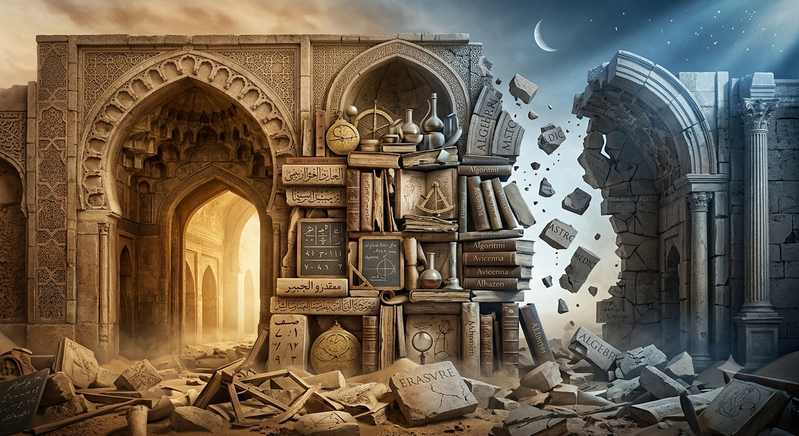
Do you ever wonder who created algebra — and why? Was it simply designed as a method of punishing students?
To answer that, we have to look much further back in history.
The Islamic Golden Age (8th–14th centuries) was a period of intense intellectual development. Centered in major cultural and scientific hubs such as Baghdad, Cairo, and Córdoba, and anchored by institutions like the House of Wisdom (Bayt al-Ḥikma), scholars drew on Greek, Persian, and Indian traditions to produce foundational advances in what we now call STEM.¹
The extent of this intellectual contribution remains widely underacknowledged in modern education, despite its lasting impact.
Mathematics, Science, and Knowledge Systems
The term algebra itself derives from al-jabr, part of the title of Muhammad ibn Mūsā al-Khwārizmī’s foundational work, which introduced systematic methods for solving linear and quadratic equations. His work also helped formalise the Hindu-Arabic numeral system, including the diffusion of zero (0) and decimal notation into mathematical practice.²
In trigonometry, scholars such as Al-Biruni and Al-Battani refined mathematical models used in astronomy, producing highly accurate sine and cosine tables that enabled precise geographic and celestial calculations.³
In optics and medicine, Ibn al-Haytham (Alhazen) challenged prevailing Greek theories of vision, demonstrating that sight occurs through light reflecting from objects into the eye — a principle that anticipates elements of the modern scientific method.⁴ Ibn Sina (Avicenna), meanwhile, authored The Canon of Medicine, a text that remained a central reference in both Islamic and European medical schools for centuries.⁵
In chemistry and experimental science, Jabir ibn Hayyan developed early laboratory techniques including distillation, crystallisation, and evaporation.⁶ Alongside these developments, astronomers constructed observatories, refined the astrolabe, and developed planetary models that influenced later European scientific work.
The Translation Movement
During the 12th and 13th centuries, scholars in regions such as Toledo and Sicily translated vast bodies of Arabic scientific literature into Latin. While early translations often preserved attribution, over time names were Latinised and gradually detached from their original cultural context.⁷
Al-Khwārizmī became Algoritmi, Ibn Sina became Avicenna, and Ibn Rushd became Averroes.
As these texts were absorbed into European universities and later developed during the Renaissance, the connection to their original authors became increasingly fragmented in standard historical narratives.
Epistemic Erasure and Historical Framing
This process is not easily reduced to simple ideas of theft or omission. Rather, it reflects the structural way historical knowledge is recorded and transmitted by later dominant intellectual systems.
As Western Europe became the centre of printing, academic production, and global expansion, historical narratives were increasingly standardised around a Eurocentric lineage of knowledge — often tracing intellectual progress directly from Ancient Greece to Renaissance Europe, while downplaying the intervening centuries of Islamic scholarship.
In modern terms, the appropriation of intellectual work without attribution would constitute a breach of academic integrity. However, before the emergence of modern citation systems and intellectual property law, knowledge circulated as a shared resource, shaped by translation, transmission, and reinterpretation.
Ultimately, the history of mathematics and science reveals a deeper structural reality: while the laws of nature remain objective, the record of discovery is shaped by those who control the preservation and narration of knowledge.
"Blind following of tradition is an inherent characteristic of human beings... The past resembles the future more than one drop of water resembles another.”
— Ibn Khaldun, The Muqaddimah
Footnotes
George Saliba, Islamic Science and the Making of the European Renaissance (MIT Press 2007) 45–52.
S. Frederick Starr, Lost Enlightenment: Central Asia’s Golden Age from the Arab Conquest to Tamerlane (Princeton University Press 2013) 221–225.
Ehsan Masood, Science and Islam: A History (Icon Books 2009) 88–92.
A I Sabra, The Optics of Ibn al-Haytham (Warburg Institute 1989) 1–10.
L. E. Goodman, Ibn Sina (Routledge 1992) 132–140.
Paul Vallely, How Islamic Inventors Changed the World (National Geographic 2006).
Charles Burnett, ‘The Coherence of the Arabic-Latin Translation Programme in Toledo in the Twelfth Century’ (2001) 4 Science in Context 249–288.
Ibn Khaldun, The Muqaddimah (F Rosenthal tr, Princeton University Press 1967) 35.
Disclaimer: The content of this post is intended purely for educational, academic discussion, and theoretical research purposes. It represents analytical speculation based on historical and legal frameworks and does not constitute legal, financial, economic, or political advice.
Image Disclaimer
The image displayed above is an artistic interpretation created entirely using artificial intelligence (AI) technology. It is a work of synthesis and imagination generated through complex algorithms and does not represent real-world photography, physical artifacts, or specific historical events. All elements within the composition are synthetic.
© 2026 Lex in Tenebris. All Rights Reserved. No part of this publication may be reproduced, distributed, or transmitted in any form or by any means without the prior written permission of the author.
Comments
No comments yet. Be the first to comment!