Rome and the Destruction of Carthage
Can Law legitimize conquest?
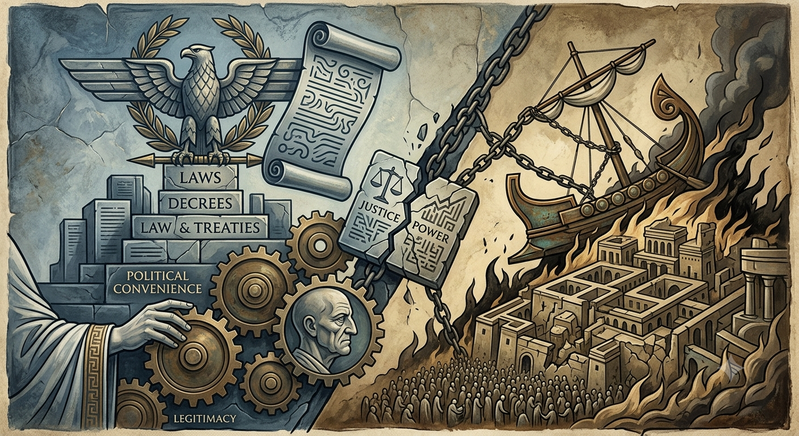
The destruction of Carthage marked the culmination of the Third Punic War. Following two devastating conflicts, the Treaty of Zama (201 BCE) imposed severe restrictions upon the Phoenician-founded city. Carthage was required to reduce its navy to just ten ships, surrender its overseas possessions and influence over Numidia, pay a substantial indemnity, and seek Rome's permission before declaring war. Once the dominant naval power of the western Mediterranean, Carthage had been reduced to a state incapable of posing an immediate military threat. The loss of its fleet not only weakened its defences but also crippled the maritime economy upon which its prosperity had long depended.
When the treaty expired in 151 BCE, Numidia—Rome's ally under King Masinissa—continued expanding into disputed Carthaginian territory. This time, Carthage chose to defend itself militarily. Since the treaty had already lapsed, the Carthaginians considered their response lawful. Rome, however, interpreted the action differently.
Among the loudest advocates for war was Cato the Elder, who famously concluded every speech with the words Carthago delenda est ("Carthage must be destroyed"). Ancient sources recount that he once displayed fresh Carthaginian figs before the Senate, arguing that because the fruit had not yet spoiled, Carthage was much closer—and therefore much more dangerous—than many senators believed.
Not everyone agreed. According to later Roman writers, Publius Cornelius Scipio Nasica Corculum argued that preserving Carthage would ultimately benefit Rome. A powerful rival, he believed, restrained Roman excesses and encouraged civic discipline. Later tradition even attributes to him the phrase Carthago servanda est ("Carthage must be preserved"), although historians continue to debate whether he ever actually uttered those words. Despite these warnings, Cato's position prevailed, and the Senate declared Carthage's military response a violation worthy of war.
This decision raises an uncomfortable question.
Had Carthage truly committed an act of unlawful aggression, or had Rome simply found the legal justification it had been searching for?
By treating Carthage's defence as a breach of its obligations, Rome transformed a highly contested legal situation into grounds for total war. Yet Carthage had spent decades complying with Rome's demands, possessed only a fraction of its former military strength, and was responding to continuous pressure from Numidia. Whether its actions were legally permissible remains debated, but Rome's reaction extended far beyond restoring peace or enforcing treaty obligations.
The Third Punic War ended not with a negotiated settlement, but with the complete destruction of Carthage. The city was systematically burned, its surviving inhabitants were sold into slavery, and one of Rome's oldest rivals disappeared entirely from the political map.
The scale of the destruction invites a broader reflection. If the objective had merely been self-defence, the elimination of an already weakened state appears difficult to reconcile with that purpose. Rome had not only defeated its enemy; it had erased it.
The episode illustrates how the language of law and treaties can become a powerful instrument of political legitimacy. A legal argument, even when contested, can transform military ambition into apparent necessity and conquest into enforcement.
History repeatedly demonstrates that legality and justice are not synonymous. A government may act within a legal framework while pursuing objectives rooted in fear, ambition, or political convenience. Law, after all, is capable of restraining power—but it is equally capable of legitimising it.
The destruction of Carthage therefore poses a question that extends far beyond Ancient Rome.
When law is used to justify the elimination of a rival, does it remain an instrument of justice—or does it become merely another weapon of power?
"Ceterum censeo Carthaginem esse delendam."
("Furthermore, I consider that Carthage must be destroyed.")
— Cato the Elder
Footnotes:
Polybius, The Histories (Robin Waterfield tr, Oxford University Press 2010) bks 15 and 36.
The Rise of Rome (Random House 2012) 350–364.
Carthage Must Be Destroyed (Penguin 2011) 318–348.
Plutarch, Life of Cato the Elder in Parallel Lives (Bernadotte Perrin tr, Harvard University Press 1914) 27.
Disclaimer: The content of this post is intended purely for educational, academic discussion, and theoretical research purposes. It represents analytical speculation based on historical and legal frameworks and does not constitute legal, financial, economic, or political advice.
Image Disclaimer
The image displayed above is an artistic interpretation created entirely using artificial intelligence (AI) technology. It is a work of synthesis and imagination generated through complex algorithms and does not represent real-world photography, physical artifacts, or specific historical events. All elements within the composition are synthetic.
© 2026 Lex in Tenebris. All Rights Reserved. No part of this publication may be reproduced, distributed, or transmitted in any form or by any means without the prior written permission of the author.
Comments
No comments yet. Be the first to comment!