The Korean Peninsula
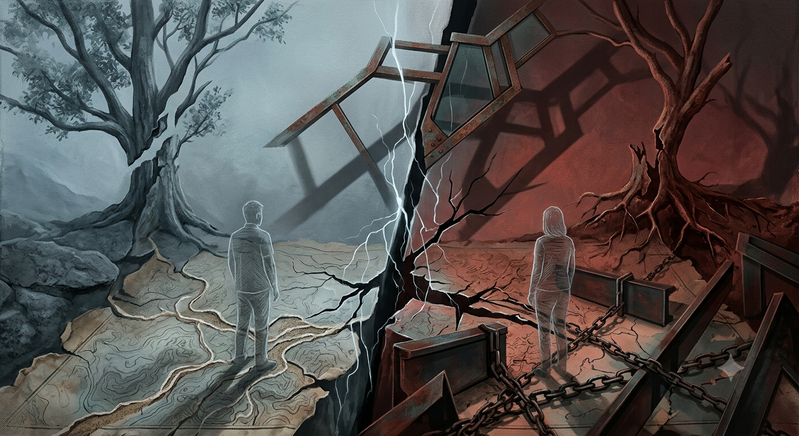
Would it be just if a decision that shaped the rest of your life were made without your consent?
Intuitively, no.
Yet this has happened far more often than we might like to admit.
In 1945, millions of Koreans woke up in the same country they had always known. Soon afterwards, they found themselves living on opposite sides of a border they had never voted for, negotiated, or even been consulted about.
Following Japan's surrender at the end of the Second World War, the Korean Peninsula was divided along the 38th parallel into two military occupation zones administered by the Soviet Union in the north and the United States in the south.¹ What was initially intended as a temporary administrative arrangement soon became a permanent political reality.
The division was not designed to reflect the wishes of the Korean people. Rather, it reflected the strategic interests of two emerging superpowers. As the Cold War intensified, Korea became more than a nation recovering from decades of Japanese colonial rule; it became a frontier between competing political ideologies.
This raises a broader question.
Can justice exist when the people most affected are never asked?
The consequences of the division extended far beyond politics. Families were separated, communities fractured, and friendships severed. Many believed the separation would be temporary. Instead, it became one of the longest-lasting divisions in modern history. Countless relatives spent decades without seeing one another, while others died before they ever had the opportunity.
Some argue that the division was unavoidable. The Second World War had only just ended, tensions between the Soviet Union and the United States were escalating rapidly, and military administrators needed a practical solution to accept the Japanese surrender. From this perspective, the partition was a temporary measure born out of necessity rather than malice.
Necessity, however, is not the same as justice.
A decision may be politically expedient while remaining deeply unfair to those who must live with its consequences. History repeatedly forces us to distinguish between what governments considered practical and what was morally right.
Modern international law attempts to address this tension through the principle of self-determination: the idea that peoples have the right to determine their own political status and freely pursue their economic, social, and cultural development.² Although this principle has become a cornerstone of international law, the history of Korea demonstrates how geopolitical interests have often prevailed over the voices of the people themselves.
More than seventy years later, the peninsula remains divided. The border that began as a temporary military line has evolved into one of the most heavily fortified frontiers in the world.³ The political circumstances that created it have changed dramatically, yet millions continue to live with the consequences of a decision made long before many of them were even born.
History reminds us that borders can be drawn with rulers and pens, but their consequences are measured in human lives.
"Salus populi suprema lex esto."⁴
("The welfare of the people shall be the supreme law.")
— Cicero, De Legibus
If the welfare of the people is truly the highest law, then perhaps the legitimacy of any political decision should ultimately be judged not by the interests it serves, but by whether it respects the people whose lives it transforms.
Footnotes
1. Bruce Cumings, The Korean War: A History (Modern Library 2010) 7–14.
2. Charter of the United Nations (signed 26 June 1945, entered into force 24 October 1945) 1 UNTS XVI, art 1(2); International Covenant on Civil and Political Rights (adopted 16 December 1966, entered into force 23 March 1976) 999 UNTS 171, art 1.
3. Don Oberdorfer and Robert Carlin, The Two Koreas: A Contemporary History (3rd edn, Basic Books 2013) 1–9.
4. Cicero, De Legibus III.3.8 (Clinton W Keyes tr, Harvard University Press 1928).
Disclaimer: The content of this post is intended purely for educational, academic discussion, and theoretical research purposes. It represents analytical speculation based on historical and legal frameworks and does not constitute legal, financial, economic, or political advice.
Image Disclaimer
The image displayed above is an artistic interpretation created entirely using artificial intelligence (AI) technology. It is a work of synthesis and imagination generated through complex algorithms and does not represent real-world photography, physical artifacts, or specific historical events. All elements within the composition are synthetic.
© 2026 Lex in Tenebris. All Rights Reserved. No part of this publication may be reproduced, distributed, or transmitted in any form or by any means without the prior written permission of the author.
Comments
No comments yet. Be the first to comment!