The Japanese Empire
Can violence be justified by progress?
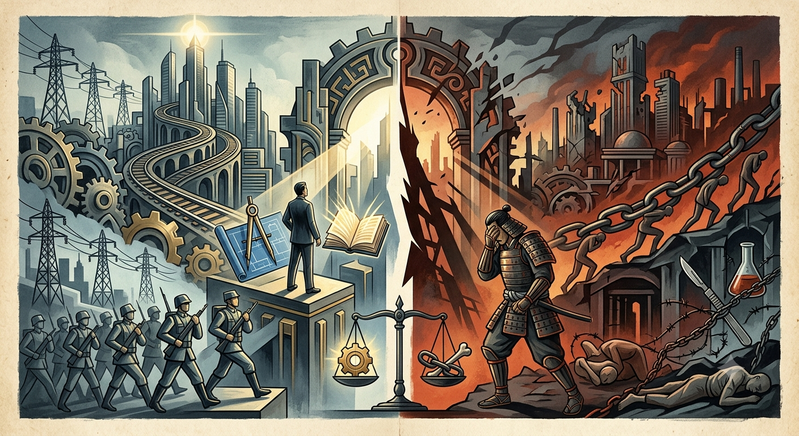
Is it possible to separate a nation’s progress from the violence it uses to achieve it?
And if progress is the result, does that risk making violence easier to justify?
This question is not purely historical. It concerns how societies interpret the relationship between achievement and its cost: whether success can be evaluated independently from the methods used to obtain it.
States often present periods of rapid development as narratives of progress, yet these same periods frequently involve coercion, conflict, or systemic violence.
Few examples illustrate this dilemma more clearly than the Japanese Empire.
During the late nineteenth century, Japan transformed itself from a largely feudal society into one of the world's leading industrial and military powers. The Meiji Restoration introduced compulsory education, modern industry, an advanced legal system, railways, factories, and a professional army. Within a few decades, Japan had become the first Asian nation to defeat a major European power in modern warfare. To many, it represented an extraordinary success story.
Yet this progress did not occur in isolation.
Industrial expansion was accompanied by imperial expansion. Korea was annexed, large areas of China were occupied, and military conquest became an instrument of national policy. As Japan's empire grew, so too did reports of forced labour, mass killings, and systematic violence against civilian populations.
The most disturbing example remains Unit 731. Under the guise of scientific research, prisoners were subjected to biological experiments without consent. Human beings ceased to be treated as persons and instead became instruments of military advancement. Medical knowledge was undoubtedly produced, but at the cost of deliberately violating the very dignity that medicine is meant to protect.¹
This raises a difficult question. If scientific discoveries obtained through immoral means later benefit humanity, should those discoveries be celebrated independently of the methods by which they were acquired?
One possible answer is yes.
Knowledge itself is morally neutral. A scientific discovery does not become false because those who uncovered it acted immorally. Likewise, Japan's technological achievements after the Second World War—its innovations in engineering, robotics, manufacturing and transport—have improved millions of lives across the globe. To reject every achievement associated with a nation because of its past risks ignoring genuine contributions to humanity.
However, separating achievement from conduct carries its own danger.
If society praises the outcome while overlooking the means, it risks creating the impression that success excuses misconduct.
The greater the reward attached to progress, the easier it becomes for governments to portray violence as a regrettable but necessary sacrifice. History repeatedly demonstrates how appeals to national security, scientific advancement, or economic development can be used to justify actions that would otherwise be considered indefensible.
The issue, therefore, is not whether Japan achieved remarkable progress. It undoubtedly did. The real question is whether that progress can erase the moral responsibility attached to the methods through which part of it was obtained.
Modern international law suggests that it cannot. The prohibition of war crimes and crimes against humanity rests upon the principle that certain acts remain unlawful regardless of the benefits they may produce. Human dignity imposes limits on what states are permitted to do, even in pursuit of legitimate objectives.²
A nation should neither be remembered solely for its atrocities nor celebrated without acknowledging them. Progress deserves recognition, but never exemption from moral scrutiny. To separate a nation's achievements entirely from its conduct is to risk rewriting history into a catalogue of victories while forgetting those who paid the price.
“The reputation of a thousand years may be determined by the conduct of one hour."
— Japanese proverb
History remembers both achievement and atrocity. The true measure of a nation is not only what it builds, but also what it is willing to destroy in order to build it. Progress may explain violence, but it cannot erase it.
Footnotes
Sheldon H Harris, Factories of Death: Japanese Biological Warfare, 1932–45, and the American Cover-Up (2nd edn, Routledge 2002).
Charter of the International Military Tribunal (London Charter) (signed 8 August 1945) 82 UNTS 279; Agreement for the Prosecution and Punishment of the Major War Criminals of the European Axis.
Disclaimer: The content of this post is intended purely for educational, academic discussion, and theoretical research purposes. It represents analytical speculation based on historical and legal frameworks and does not constitute legal, financial, economic, or political advice.
Image Disclaimer
The image displayed above is an artistic interpretation created entirely using artificial intelligence (AI) technology. It is a work of synthesis and imagination generated through complex algorithms and does not represent real-world photography, physical artifacts, or specific historical events. All elements within the composition are synthetic.
© 2026 Lex in Tenebris. All Rights Reserved. No part of this publication may be reproduced, distributed, or transmitted in any form or by any means without the prior written permission of the author.
Comments
No comments yet. Be the first to comment!