Divine law vs Human law
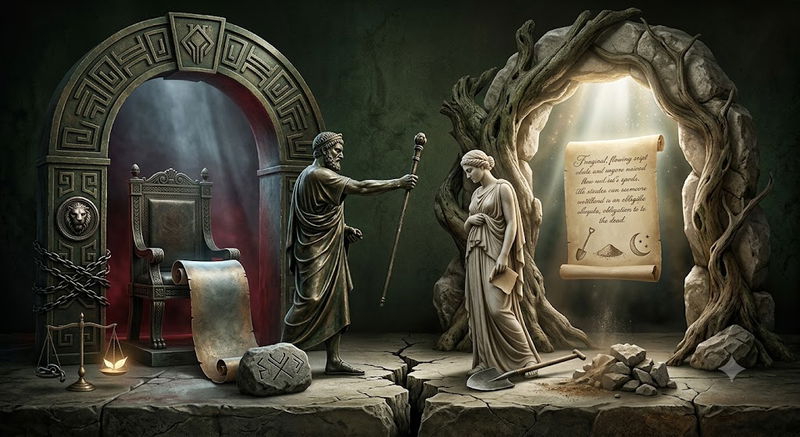
Ancient Greek tragedian Sophocles' Antigone is more than a theatrical masterpiece. It is one of the earliest explorations of a question that continues to challenge legal systems today:
What should happen when the law commands one thing, but morality commands another?
Following the fall of the royal house of Thebes, Oedipus' sons, Eteocles and Polynices, were meant to rule together by alternating the throne each year. When Eteocles refused to surrender power, Polynices raised an army against his own city. Both brothers died in battle, leaving their uncle, Creon, to inherit the throne.
To reinforce his authority and discourage future rebellion, Creon declared Eteocles a national hero and ordered him a ceremonial burial. Polynices, branded a traitor, was denied burial altogether, with the penalty of death for anyone who attempted to honour his body.
Antigone, sister to both men, faced an impossible dilemma. She had promised Polynices that she would bury him, and according to the religious customs of Ancient Greece, denying someone burial condemned their soul to wander without peace. Torn between obedience to the king and obedience to divine duty, she chose the latter. She buried her brother knowing that death would almost certainly follow.
Creon refused to pardon her despite the pleas of his son, Haemon, who was engaged to Antigone. Only after the prophet Tiresias warned him that he had angered the gods did Creon reconsider. By then, it was too late. Antigone had taken her own life, Haemon killed himself beside her, and Queen Eurydice, devastated by the loss of her son, followed him in death.
Sophocles does not present heroes and villains. He presents two individuals who believe they are acting justly.
Creon views law as the foundation of political order. A king who allows rebellion to go unpunished invites further rebellion. To him, the stability of the state outweighs personal relationships, and making an exception for his own family would undermine both his authority and the law itself.
Antigone sees the matter differently. Certain duties, she believes, exist independently of any ruler. A king may prohibit burial, but he cannot abolish the moral obligation to honour one's family or the divine laws that, in Greek belief, governed the dead. In her eyes, obedience to an unjust command is itself an injustice.
Both positions possess a degree of legitimacy, yet both are deeply flawed.
Creon's commitment to public order gradually transforms into stubbornness. Rather than asking whether justice has been achieved, he becomes determined to prove that his authority cannot be challenged. His decree ceases to serve the city and instead serves his pride.
Antigone, however, is not beyond criticism. Although morally convinced of her duty, she leaves almost no room for dialogue or compromise. She openly embraces martyrdom instead of attempting to persuade Creon before openly defying him. Her certainty becomes as absolute as his.
The tragedy therefore arises not because one side is entirely right and the other entirely wrong, but because neither is willing to question their own certainty.
This raises a broader legal question.
Can a law itself become unjust?
If laws are created by human beings, then they inevitably reflect human judgment, human limitations, and sometimes human bias. The mere existence of a law does not guarantee its justice. History offers countless examples of legal systems that were entirely lawful while remaining profoundly immoral.
Equally, however, allowing every individual to disobey any law they personally consider unjust would make the rule of law impossible. A society cannot function if every citizen becomes the sole judge of which laws deserve obedience.
The conflict between Antigone and Creon therefore exposes a dilemma that remains unresolved in modern jurisprudence. Law requires obedience to preserve order, yet morality occasionally demands resistance when that order itself becomes unjust.
Perhaps the greatest lesson of Antigone is not that either character was correct, but that justice cannot survive where certainty replaces dialogue. Creon mistakes authority for justice. Antigone mistakes conviction for wisdom. Neither truly listens to the other until every opportunity for reconciliation has disappeared.
The world is rarely divided between right and wrong. More often, it is divided between competing duties, competing loyalties, and competing understandings of justice.
That is precisely why Antigone continues to matter over two thousand years later.
"Nor did I think your edicts had such force that you, a mere mortal, could override the unwritten and unfailing laws of the gods.”
–Antigone
Footnotes:
Sophocles, Antigone (Hugh Lloyd-Jones tr, Harvard University Press 1994).
Aristotle, Nicomachean Ethics (Roger Crisp tr, Cambridge University Press 2000) bk V (on justice and equity).
HLA Hart, The Concept of Law (3rd edn, Oxford University Press 2012) chs 8–9 (on law, obligation, and morality)
Sophocles, Antigone (Hugh Lloyd-Jones tr, Harvard University Press 1994) ll 450–457.
Disclaimer: The content of this post is intended purely for educational, academic discussion, and theoretical research purposes. It represents analytical speculation based on historical and legal frameworks and does not constitute legal, financial, economic, or political advice.
Image Disclaimer
The image displayed above is an artistic interpretation created entirely using artificial intelligence (AI) technology. It is a work of synthesis and imagination generated through complex algorithms and does not represent real-world photography, physical artifacts, or specific historical events. All elements within the composition are synthetic.
© 2026 Lex in Tenebris. All Rights Reserved. No part of this publication may be reproduced, distributed, or transmitted in any form or by any means without the prior written permission of the author.
Comments
No comments yet. Be the first to comment!