Two Swords, One World: Dante Alighieri and the Struggle Between Empire and Church
Throughout history, one question has repeatedly challenged political and legal systems: who has the right to rule? When two institutions claim authority over the same people, can they coexist, or must one inevitably dominate the other?
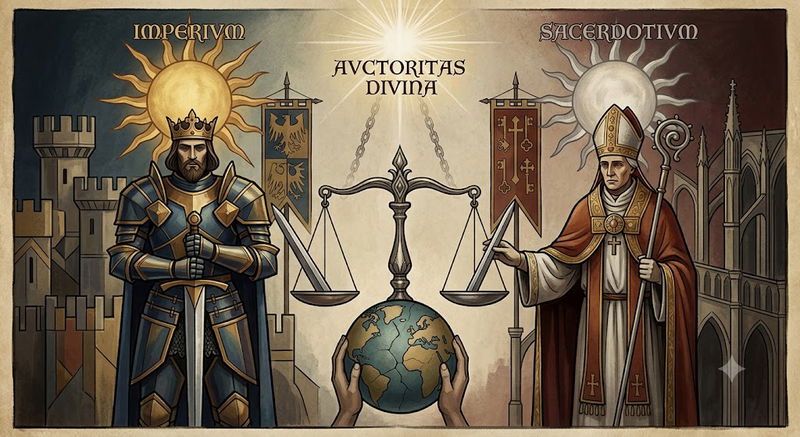
In medieval Europe, this question took the form of a struggle between two universal powers: the Holy Roman Emperor and the Pope. The Emperor claimed authority over earthly affairs, while the Pope increasingly asserted that spiritual authority granted him superiority even over kings. In the midst of this conflict, Dante Alighieri wrote De Monarchia, a political treatise defending the independence of imperial power from papal control.
Dante’s work was not merely a political argument. It was a debate about legitimacy, law, and the limits of authority itself.
The Conflict of the Two Powers
During the Middle Ages, political and religious authority were deeply connected. The Church was not only a spiritual institution but also a powerful political force, possessing wealth, territory, and influence over European rulers.
The argument used by supporters of papal supremacy was based on the belief that spiritual authority was superior to temporal authority. Since the soul was considered greater than the body, the institution responsible for guiding souls—the Church—was considered greater than earthly governments.
This idea reached one of its strongest expressions under Pope Boniface VIII, who declared in Unam Sanctam (1302):
“It is absolutely necessary for salvation that every human creature be subject to the Roman Pontiff.”¹
This statement represented the belief that the Pope possessed authority not only over spiritual matters but also over political rulers. If every human being was subject to the Pope for salvation, then kings and emperors could not be entirely independent from papal judgement.
Dante challenged this idea.
In De Monarchia, written around 1313, he argued that humanity possessed two distinct purposes and therefore required two distinct authorities.
According to Dante, humans pursued:
earthly happiness through reason, justice, and philosophy;
eternal happiness through faith and divine revelation.
Because these goals were different, the institutions responsible for guiding humanity toward them should also remain separate.
Dante wrote:
“The ineffable Providence has set before man two ends: namely, the happiness of this life, which consists in the exercise of his own powers and is represented by the earthly Paradise; and the happiness of eternal life, which consists in the enjoyment of the divine vision.”²
For Dante, the Emperor and the Pope were not competing rulers over the same domain. They represented two different forms of guidance.
Authority Directly From God
The central argument of De Monarchia is Dante’s rejection of the idea that imperial authority originated from the Pope.
If the Emperor received his legitimacy through the Church, then political authority would ultimately become dependent upon religious authority. The Emperor would not truly govern independently; he would simply exercise power granted by another institution.
Dante rejected this hierarchy.
He argued that both forms of authority came directly from God:
“The temporal authority of the Monarch descends upon him without any intermediary from the Fountainhead of universal authority.”³
This argument was revolutionary because it challenged the idea that all earthly power had to pass through the Church before becoming legitimate.
Dante was not arguing that the Church had no authority. Instead, he argued that the Church and the Empire had separate responsibilities. The Pope guided humanity toward eternal salvation; the Emperor guided humanity toward peace and justice in earthly life.
Neither institution should absorb the role of the other.
The Two Suns
Supporters of papal supremacy often argued that there could only be one supreme authority, just as there was only one sun illuminating the world.
Dante rejected this comparison.
Instead, he suggested that humanity required two forms of light: one spiritual and one temporal.
The Church represented spiritual guidance.
The Empire represented political order.
Both were necessary because humans existed between two worlds: the earthly and the divine.
This idea presents an early argument for the separation and limitation of power. When one institution attempts to control every aspect of human existence, authority risks becoming domination.
Was Dante Defending Justice or Another Form of Absolute Power?
Dante’s argument remains fascinating because it contains a contradiction.
On one hand, De Monarchia challenges the idea that one institution should possess unlimited control. Dante argues that authority requires boundaries and that political power should not be completely subordinated to religious power.
However, Dante’s solution was not modern democracy or constitutional government. He still defended the idea of a universal monarchy led by an Emperor with enormous authority.
Therefore, Dante opposed one form of absolute power while defending another.
This does not weaken his argument. Instead, it reveals the complexity of political thought. Dante was not writing in a modern world of constitutions, elections, and human rights. He was responding to the conflicts of his own era.
His lasting contribution was the recognition that even legitimate authority requires limits.
Conclusion: The Eternal Question of Authority
Dante’s De Monarchia is more than a medieval political treatise. It is an exploration of a question that remains relevant today:
When two institutions claim the right to command, how do we determine which one is legitimate?
Dante believed the answer was not domination, but balance. The Church and the Empire were not meant to destroy each other, but to operate within their own spheres.
Although his vision belonged to a world of emperors, popes, and divine monarchy, the principle behind his argument remains familiar: power must have boundaries, because authority without restraint can become injustice.
Centuries later, legal systems continue to debate the same fundamental issue Dante explored:
Who watches those who hold power?
Footnotes
¹ Pope Boniface VIII, Unam Sanctam (1302), translated in Ernest F. Henderson, Select Historical Documents of the Middle Ages (George Bell and Sons, 1896).
² Dante Alighieri, De Monarchia, Book III, Chapter 16, translated by Aurelia Henry (Boston: Houghton Mifflin, 1904).
³ Dante Alighieri, De Monarchia, Book III, Chapter 15, translated by Aurelia Henry (Boston: Houghton Mifflin, 1904).
Bibliography
Dante Alighieri. De Monarchia. Translated by Aurelia Henry. Boston: Houghton Mifflin, 1904.
Boniface VIII. Unam Sanctam. 1302.
Tierney, Brian. The Crisis of Church and State 1050–1300. Toronto: University of Toronto Press, 1988.
Ullmann, Walter. A History of Political Thought: The Middle Ages. London: Penguin Books, 1965.
Disclaimer: The content of this post is intended purely for educational, academic discussion, and theoretical research purposes. It represents analytical speculation based on historical and legal frameworks and does not constitute legal, financial, economic, or political advice.
Image Disclaimer
The image displayed above is an artistic interpretation created entirely using artificial intelligence (AI) technology. It is a work of synthesis and imagination generated through complex algorithms and does not represent real-world photography, physical artifacts, or specific historical events. All elements within the composition are synthetic.
© 2026 Lex in Tenebris. All Rights Reserved. No part of this publication may be reproduced, distributed, or transmitted in any form or by any means without the prior written permission of the author.
Comments
No comments yet. Be the first to comment!