Nuclear Power: The Fear of the Atom
There are few things we fear quite like the atom.
It is invisible. It is powerful. And, in the twentieth century, it became synonymous with a mushroom cloud.
But the same physics that gave humanity nuclear weapons also gave us something much quieter: electricity.
A nuclear power plant does not explode like a nuclear bomb. Its basic principle is surprisingly ordinary. A nuclear reactor uses fission: atoms of heavy elements such as uranium split apart, releasing energy. That energy heats water, the water becomes steam, the steam turns a turbine, and the turbine generates electricity.[1]
In other words, beneath all the complicated physics, a nuclear power plant is essentially a very sophisticated way of boiling water.
And yet, the word nuclear makes that sentence feel much more frightening than it should.
Perhaps because nuclear energy carries a peculiar contradiction.
It can produce enormous amounts of electricity without directly releasing carbon dioxide during operation. Unlike fossil-fuel plants, it does not need to burn coal, oil or gas to generate heat. This makes nuclear power particularly interesting in a world attempting to reduce greenhouse-gas emissions.[2]
But low carbon does not mean no environmental cost.
Uranium has to be mined and processed. Nuclear plants require enormous amounts of infrastructure and cooling water. And then there is the problem that has followed nuclear energy since its beginning:
What do we do with the waste?
Some radioactive materials remain dangerous for extremely long periods of time. Modern nuclear waste management can isolate and contain these materials, but the underlying question remains unsettling. We are producing substances that can outlast entire civilizations.[3]
Then there are nuclear accidents.
Chernobyl. Fukushima.
Two disasters, two very different circumstances, both permanently embedded in the public imagination.
They remind us that nuclear technology does not merely require scientific knowledge. It requires institutions capable of maintaining safety for decades, sometimes across generations. A reactor can be extraordinarily well engineered, but technology exists within human systems. Engineers make decisions. Governments regulate. Companies manage costs. People make mistakes.[4]
And this raises a question that is perhaps more important than “Is nuclear power dangerous?”
Everything is dangerous.
Coal pollution kills people. Oil spills destroy ecosystems. Gas infrastructure can fail. Hydroelectric dams can collapse. Wind turbines require materials and land. Solar panels require mining and manufacturing.
The more useful question is:
How much risk are we willing to accept for the benefits a technology provides?
Nuclear power complicates this question because its risks are unusual.
A coal plant releases pollution continuously, while a nuclear accident may produce an extremely concentrated disaster. Nuclear waste is hazardous for extraordinary lengths of time, while fossil-fuel waste is released into the atmosphere and affects the climate immediately.
So perhaps comparing nuclear power with an imaginary “safe” alternative misses the point.
The real choice is between different kinds of risk.
And there is another uncomfortable irony.
The technology that can generate electricity without burning fossil fuels is also one of the technologies most associated with humanity's ability to destroy itself.
The atom itself is not moral.
It does not know whether it is being used to illuminate a hospital, power a city, or build a weapon.
We decide what its energy becomes.
That may be the most important lesson of nuclear power.
The question is not whether humanity should fear the atom.
Perhaps the better question is whether humanity has become responsible enough to use it.
And if the answer is yes, how do we prove it?
“The release of atomic energy has not created a new problem. It has merely made more urgent the necessity of solving an existing one.”
— Albert Einstein, 1945[5]
Footnotes:
[1] International Atomic Energy Agency (IAEA), Nuclear Power and Sustainable Development; see also IAEA educational material on nuclear fission and nuclear power generation.
[2] Intergovernmental Panel on Climate Change (IPCC), Climate Change 2014: Mitigation of Climate Change, which assesses the lifecycle greenhouse-gas emissions of different electricity-generation technologies. Nuclear power has very low lifecycle greenhouse-gas emissions compared with fossil-fuel generation.
[3] International Atomic Energy Agency (IAEA), Radioactive Waste Management; radioactive waste varies considerably in its level of radioactivity and required isolation period, with some high-level waste remaining hazardous for very long periods.
[4] United Nations Scientific Committee on the Effects of Atomic Radiation (UNSCEAR), assessments of the health and environmental consequences of the Chernobyl and Fukushima accidents. The two accidents occurred under substantially different circumstances and had different consequences.
[5] Albert Einstein, “Atomic War or Peace,” The Atlantic Monthly, November 1945. Einstein's statement appeared in the context of the political and ethical consequences of the development of atomic energy.
Disclaimer: The content of this post is intended purely for educational, academic discussion, and theoretical research purposes. It represents analytical speculation based on historical and legal frameworks and does not constitute legal, financial, economic, or political advice.
Image Disclaimer
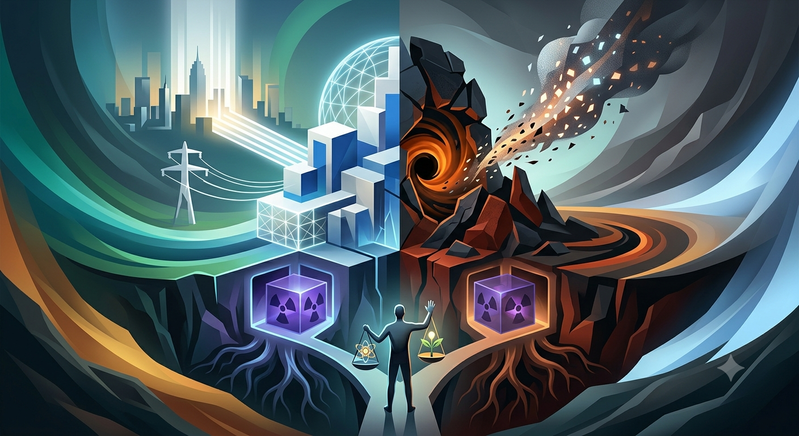
The image displayed above is an artistic interpretation created entirely using artificial intelligence (AI) technology. It is a work of synthesis and imagination generated through complex algorithms and does not represent real-world photography, physical artifacts, or specific historical events. All elements within the composition are synthetic.
© 2026 Lex in Tenebris. All Rights Reserved. No part of this publication may be reproduced, distributed, or transmitted in any form or by any means without the prior written permission of the author.
Comments
No comments yet. Be the first to comment!