Four Men and Women of God: What I Promessi Sposi Reveals About the Church
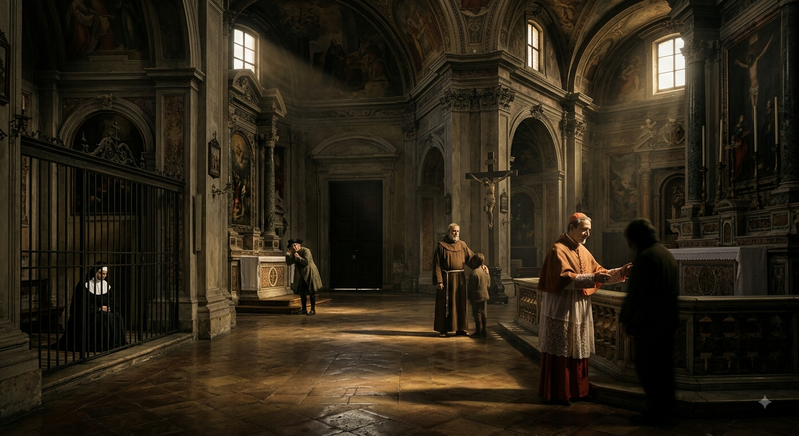
When we think about I Promessi Sposi, we often think of Renzo and Lucia, Don Rodrigo, the plague, or the famous opening sentence. Yet some of the novel's most revealing characters are those who belong to the Church.
Manzoni does not present the Church as a single, uniform institution. Instead, he places four ecclesiastical figures at its centre: Don Abbondio, Fra Cristoforo, Gertrude—the Monaca di Monza—and Cardinal Federigo Borromeo. They are radically different from one another, but together they form a remarkably precise portrait of religious life and its contradictions.
The first is Don Abbondio, perhaps the least heroic priest in Italian literature. His defining characteristic is fear. When Don Rodrigo's bravi threaten him, he does not defend Renzo and Lucia; he simply tries to protect himself. His priesthood appears less like a vocation than a safe position in an unsafe world. His famous philosophy is essentially that of someone who has decided that survival is more important than courage.[1]
Don Abbondio is therefore not merely a comic character. Through him, Manzoni criticises a clergy that has become detached from the moral responsibility of its own office. He is a priest, but when confronted with injustice, he behaves like an ordinary frightened man. His religion does not give him the courage to act.
Fra Cristoforo represents the opposite. Before becoming a friar, Ludovico was proud, impulsive and capable of violence. His transformation does not erase his personality; rather, it redirects his energy towards protecting others. His confrontation with Don Rodrigo is therefore one of the novel's clearest examples of Christianity becoming action.[2]
The contrast between Don Abbondio and Fra Cristoforo is particularly important. Both are members of the same Church and both are exposed to the same violent society. Yet one retreats from injustice while the other confronts it. Manzoni therefore does not seem to ask whether the Church is good or bad. He asks a more uncomfortable question: what does a religious vocation actually mean if it does not produce moral courage?
The two other figures complicate this opposition because they belong to the upper social world: Gertrude and Federigo Borromeo.
Gertrude, the Monaca di Monza, is one of the novel's most tragic characters. Unlike Don Abbondio, she is not simply motivated by cowardice. Her life has been shaped by coercion. Born into an aristocratic family, she is pushed towards the convent because her family wants to preserve its social and economic interests. Her religious life therefore begins without genuine freedom.
Her story exposes another problem: the use of religious institutions to preserve social structures. Gertrude is forced into a role she did not freely choose, and the result is disastrous both for herself and for others. Her subsequent relationship with Egidio and her involvement in crime reveal a profound conflict between external religious identity and internal conscience.[3]
Then comes Federigo Borromeo, who provides the fourth and most authoritative model. Historically, Borromeo was a real seventeenth-century cardinal, and Manzoni gives him an extensive biographical portrait. Yet even here, Manzoni does not simply create a flawless saint. The narrator admires him while also allowing the reader to notice the limitations and prejudices of his historical context.[4]
Federigo's greatest strength is that his authority is transformed into service. His encounter with the Innominato is perhaps the clearest example. The cardinal does not defeat him through political power or physical force. He responds with compassion and offers the possibility of redemption. The Innominato, who has been feared by almost everyone around him, is confronted by someone who does not fear him.
This gives us the novel's fundamental division:
Don Abbondio and Gertrude represent a Church in which religious identity has become separated from genuine moral responsibility. Fra Cristoforo and Federigo represent a Church in which faith becomes charity, courage and action.
But there is another important detail. Manzoni deliberately distributes these four figures across social classes. Don Abbondio and Fra Cristoforo come from comparatively humble backgrounds, while Gertrude and Federigo belong to the aristocratic world.[5] Virtue, therefore, cannot be explained by social status. Nor can corruption.
The problem is the individual conscience.
This is particularly significant when we remember when Manzoni was writing. I Promessi Sposi was published in its definitive edition between 1840 and 1842, during the period of the Risorgimento. Italy was politically fragmented, and the relationship between religion, society, political authority and emerging national identity was undergoing profound transformation.
Manzoni's historical setting is the seventeenth century, but his questions are not confined to the seventeenth century. By placing his contemporary concerns inside a historical novel, he could examine power, injustice, responsibility and social institutions without simply writing a political pamphlet.
The Church in I Promessi Sposi consequently becomes a miniature society.
It contains the cowardly official, the courageous reformer, the victim of institutional pressure and the morally authoritative leader.
And perhaps this is where Manzoni's criticism becomes most interesting: he does not reject the Church. He demands more from it.
For him, Christianity cannot be reduced to ceremonies, titles, social position or institutional authority. Its value is demonstrated through what a person does when confronted with another person's suffering.
That idea had consequences beyond the novel itself. I Promessi Sposi became one of the foundational works of modern Italian culture, particularly through Manzoni's linguistic project and his attempt to create a literary Italian accessible to a much broader population. Its influence therefore extended beyond literature into the cultural construction of nineteenth-century Italy.[6]
Yet perhaps the most enduring change is less measurable.
Manzoni gave generations of readers a way to distinguish between religion as an institution and religion as a moral responsibility.
Don Abbondio asks what will happen to himself.
Fra Cristoforo asks what he can do for others.
Gertrude shows what happens when religious identity is imposed without freedom.
Federigo shows what religious authority can become when it is transformed into compassion.
Four figures. One Church. Four radically different answers to the same question:
What does it actually mean to serve God?
And Manzoni's answer seems surprisingly demanding: it means having the courage to act when doing nothing would be easier.
“Il torto non è mai tutto da una parte.”
“The wrong is never entirely on one side.”
—Fra Cristoforo
Footnotes
[1] Don Abbondio's fear is established from his first appearance and becomes the central trait through which Manzoni constructs both his comedy and his moral weakness.
[2] Fra Cristoforo's past as Ludovico is narrated in Chapter IV. His conversion follows the killing of Cristoforo, his servant, during his violent confrontation with a nobleman. His new religious life redirects his former impulsiveness towards defending the weak.
[3] Gertrude's story occupies Chapters IX–X. Manzoni draws inspiration from the historical figure of Virginia de Leyva, known as the Monaca di Monza. Her forced entrance into religious life is essential to understanding the tragedy of her later choices.
[4] Federigo Borromeo (1564–1631) was a historical figure. Manzoni's portrait is therefore different from his treatment of invented characters, although the narrator's admiration does not prevent him from acknowledging aspects of Federigo's historical limitations.
[5] The contrast between social origin and moral character is deliberate: Fra Cristoforo and Don Abbondio belong to the humbler social world, while Gertrude and Federigo belong to the aristocracy. Virtue and corruption therefore cannot simply be associated with social class.
[6] The definitive edition of I Promessi Sposi appeared in 1840–1842. Manzoni's revision of the language, particularly his movement towards contemporary Florentine usage, contributed to the novel's extraordinary importance in the development and diffusion of modern literary Italian.
Disclaimer: The content of this post is intended purely for educational, academic discussion, and theoretical research purposes. It represents analytical speculation based on historical and legal frameworks and does not constitute legal, financial, economic, or political advice.
Image Disclaimer
The image displayed above is an artistic interpretation created entirely using artificial intelligence (AI) technology. It is a work of synthesis and imagination generated through complex algorithms and does not represent real-world photography, physical artifacts, or specific historical events. All elements within the composition are synthetic.
© 2026 Lex in Tenebris. All Rights Reserved. No part of this publication may be reproduced, distributed, or transmitted in any form or by any means without the prior written permission of the author.
Comments
No comments yet. Be the first to comment!