The trial of Galileo Galilei
When legal authority silences empirical truth
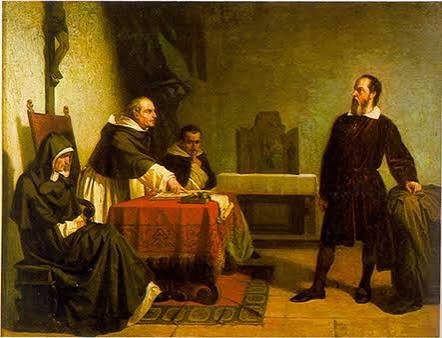
Would it be lawful to arrest a scientist for discovering something that goes against what was previously believed? Intuitively, no. Then why was it acceptable to do so with Galileo Galilei?
This blog's, Lex In Tenebris (law in the darkness), whole purpose is to analyse situations like these and question them, focusing on ethics, legislation and morality.
In 1633, The Inquisition tries Galileo, finds him "vehemently suspect of heresy," forces him to recant, and sentences him to house arrest for the rest of his life.
Now, why was this arrest acceptable?
In 1616, the Inquisition, led by Cardinal Bellarmine, declared that the heliocentric theory was "foolish and absurd in philosophy, and formally heretical". Galileo was instructed not to "hold, teach, or defend" the theory in any way, a "precept" or formal legal order. The 1633 court determined that his book violated this direct injunction.
Galileo was not charged with heresy itself—which could be a capital crime—but with "vehement suspicion of heresy," a less severe, yet serious offense that allowed for, among other penalties, imprisonment. This charge meant the Inquisition did not need to prove he believed it, only that he advocated a heresy-adjacent opinion too strongly.
Galileo was found to have obtained the license to publish his 1632 Dialogue under false pretenses. He did not inform the official printer or the licensor that he was bound by the 1616 injunction not to discuss Copernicanism at all.
The trial was viewed by the Church as a matter of obedience and discipline rather than simply a scientific disagreement. Galileo's “Dialogue” mocked the geocentric view, which was not only supported by Ptolemy but also, at the time, by the church's favored Aristotelian-Thomistic philosophy. The Pope, Urban VIII, felt that Galileo had disobeyed a personal promise to treat the model only as a mathematical hypothesis.
Under the standard rules of the Inquisition, an offense deemed "vehement suspicion of heresy" could result in strict imprisonment but due to his high age, illness, and his status as a famous scientist with connections to the Pope, the prison sentence was commuted to house arrest (or "villa arrest"). He was sentenced to formal detention "at the pleasure of the Inquisition" and was required to recite the Seven Penitential Psalms weekly for three years.
It is obvious that the Church took drastic measures against Galileo because his theories and observations went against the Aristotelian-geocentrism theory. This is a clear argumentum ab auctoritate, also called an appeal to authority, or argumentum ad verecundiam. The only reason the Church had to incriminate Galileo was that his words went against the authority's.
Is this not a threat to justice itself? Do the legal authorities still believe they are superior? Today, we replace the Inquisition with 'Public Policy' or 'National Security.' The names of the courts change, but the question remains: Can a State legally suppress a truth simply because that truth makes the State's current laws look obsolete?
The answe is no. Not, it absolutely cannot because freedom of speech is enshrined in Article 19 of the Universal Declaration of Human Rights and the International Covenant on Civil and Political Rights, protecting the right to hold opinions, express views, and seek/receive information without government interference.
If a court were to suppress this right, it would be commonly referred to as Per incuriam, meaning "because of lack of care." This refers to a judgment that was rendered in ignorance or forgetfulness of a binding legal authority or fundamental right, such as a ruling that is inconsistent with a previous human rights precedent. It can also be referred to as contra legem, meaning "against the law". In judicial practice, it refers to a decision or interpretation by a court that directly contradicts the existing written law, statute, or clear legal principles. Regarding human rights, a contra legem decision happens when a court, in its interpretation, ignores or deviates from national laws that protect fundamental rights, often resulting in a violation of those rights.
The incrimination of Galileo Galilei was reasonable at the time because the concept of Human Rights was not introduced in Italy until after the Second World War.
The Church was not the political authority in Florence but the Medici family. Why did they not intervene, when Galileo was on their payroll?
The Medici family did not stop the Roman Catholic Church from incriminating him primarily because they were politically weak in comparison to the Vatican, which was reeling from the Reformation, and because Galileo had publicly embarrassed Pope Urban VIII, a former ally. While the Medicis provided extensive patronage to Galileo for decades, the political risks of defying the Inquisition became too great, forcing Grand Duke Ferdinando II to bow to papal authority.
Galileo’s own actions had alienated his strongest allies in Rome which caused him to be isolated by the people who once supported him.
That, however, does not justify putting someone on house arrest just because their scientific discoveries don't align with established doctrines.
I quote Cicero's words from De Officiis regarding abuse of power: “Summum ius, summa iniuria.” which translates to “The stricter the law, the greater the injustice.”
Comments
No comments yet. Be the first to comment!